#nature

Tuscan Ham & Childhood Memories

As I’m cozying up by the fireplace, sipping my coffee, and watching delicate snowflakes twirl in the air, I can’t help but drift back to my childhood in the countryside, surrounded by my family.

A COMMUNITY EVENT AND A FAMILY FEAST

Late winter was usually a time of rest, a pause in nature’s cycle when there wasn’t much to do in the fields. The sun often hid behind thick clouds, and the animals on the farm preferred to stay warm inside their stables.

It seems our Tuscan ancestors decided that this was the perfect time for domestic slaughtering. The cold weather was ideal for preserving the huge amounts of meat that needed to be handled during the butchering. Back then, there weren’t any big storage cellars like we have today.

In the countryside, money wasn’t the main focus. Farmers worked hard every day to make ends meet. Everything was considered a valuable resource, and the community spirit was strong. Neighbors were often the only people farmers could rely on, besides their families. Their help and hard work were always appreciated with food, wine, and a helping hand when needed.

Pig slaughtering was a big deal for the community and a family feast, so everyone pitched in. After a long day of hard work, they looked forward to an evening of delicious pork treats and good wine. Back then, it was the only time of year when people could afford to indulge in such a large amount of meat.

Pork meat has always been a valuable part of our culinary tradition because nothing was ever wasted. Even the smallest, seemingly insignificant pieces were used. Once the butcher processed it, it became a year’s supply for the farming families and a valuable trade item for other goods or services.

Following nature’s lead, our farmers had a specific way of using the products from their animals. Everything was based on the seasons, so the first things eaten were those that needed less time to prepare and age, like jowl and pork belly.

Prosciutto crudo Toscano

In Tuscany, we have a fantastic selection of cured meats and pork products, but when we think of pork, the first thing that comes to mind is the PDO Tuscan Raw Ham (Prosciutto Crudo Toscano DOP). This dry-cured, aged raw ham, probably the best in the world, is the star of the Tuscan area, along with the Tuscan Pecorino Cheese and the Chianti Wine. It’s so special that in the past, it was the last pork product to be eaten, often up to a year later. It was the finest delicacy that farmers had, and they were often proud of it. I remember that “opening” the Prosciutto was a joyful occasion, a feast where friends and family gathered to share this delicacy, but only because the first part of the hind leg had a bit too much fat around, before revealing the finest savory, chewy bites of pure raw ham; however, that doesn’t mean it was less delicious.

The Tuscan Raw Ham comes from the oldest traditions and should not be confused with the similar Raw Ham of Parma and San Daniele. The process might seem similar, but the unique flavor and the characteristic chewy, almost buttery, and salty taste of the Tuscan PDO Raw Ham are unmistakable. This is because it’s directly related to the local aromatics, customs, and the geographical area’s temperatures and humidity.

The Tuscan Raw Ham gets its typical salty taste from… well, salt, of course. But it’s not just about how much salt you use; it’s about the aging time and the specific environment with the right level of humidity where the meat is held and cured. It’s a long-standing tradition that dates back to Medieval times, when farmers used to cure the hind legs with fennel seeds that grew wild along the Tuscan fields, along with sea salt to preserve the meat. More recently, juniper, garlic, and pepper have been added to the recipe, but it still depends on each family’s tradition and customs that have been passed down through generations.

As I recall, my father used to rub pork hind legs with a garlic and pepper pomade and let them sit on a wooden table for up to 20 days. Then, he’d wash the pomade away with vinegar and, after drying it thoroughly, rub the rind-less part again with lots of salt and pepper to keep flies from eating the meat.

In our family, we didn’t waste anything, so when the ham was gone, we used the bones to flavor simpler peasant dishes like Tuscan bread soup or bean soup. But before that, my mother always saved some marrow in a small jar in the fridge. She called it her secret medicine for when my brothers and I came home with bumps and bruises—a little scrub on the spot, and the pain would disappear. Now you might find that funny, but back then, it was a miracle medicine!

And speaking of childhood memories, the best “merenda” (snack) we ever had as kids, and that we’re still obsessed with today, was the famous “panino col pane sciabo e prosciutto” (the Tuscan unsalted white bread and raw ham sandwich). Yes, because nothing is random: the typical Tuscan unsalted white bread pairs perfectly with the salty Tuscan Raw Ham, bringing out the best in this fine cured meat. Picture eating a salted piece of bread with an even saltier piece of raw ham, or aged Pecorino cheese… it’s all been figured out since ages, no wonder our culinary matches are known worldwide!

L’Olio Novo

The Tuscan Green Gold, from the farm to the fork!

Autumn isn’t just about roasting chestnuts and sipping red wine by the fireplace. There’s hardly any time to relax when you’re living in the Tuscan countryside. Therefore, between the golden autumn leaves and the first winter chill, as soon as we’re done with the vine harvest, we have to get our strength back and be ready for a new adventure: the olive harvest.

Like every other year, we start picking olives on our farm around mid-October, just before the first chills of November. Back in the day, they used to wait for the olives to be fully mature before harvesting. But the weather wasn’t always kind to crops in late autumn, so to protect them from the early frosts, people have traditionally developed the custom we all know today: harvesting olives earlier, even before they are fully ripe.

This tradition has become an essential part of our territory’s reputation worldwide, for it has given us a unique product of excellence: “l’olio novo” toscano (the freshly pressed Tuscan extravirgin olive oil). Unique because the chemical and organoleptic characteristics of the PDO extravirgin olive oil are mostly related to the climate of the growth area, which directly influences the quality of the phenols, the bitterness, and the sharpness of the taste.

The Harvest

Harvesting olives before they’re fully ripe means they still have a high level of polyphenols. Unfortunately, this means we get less product, but it’s exactly what we need to achieve that perfect balance of intense bitterness and peppery flavor, which is so characteristic of Tuscan extra virgin olive oil. However, the final taste of each batch also depends on many other factors, so it’s almost impossible to have two different productions with the same taste, even in the same area.

As we always do on our farm, harvesting olives is a group activity. Farming is a physically demanding job, and any extra help is always appreciated. Traditionally, during the olive harvest, close relatives, friends, or neighbors from nearby farms come together to lend a hand and spend some fun days outdoors, enjoying the stunning views of the Tuscan hills. Everyone participates in the process, and seeing the product go from the olive grove to the table is really exciting for everyone.

The day begins very early in the morning, with rubber boots, comfortable clothes, and tools of the trade, we head to our small olive grove and start picking up the little green-purple gems. What we love most is that our family still keeps the tradition alive from past generations, and a day of hard work on the farm can easily turn into a celebration. We love to bring back the old-fashioned charm of country living, just like our grandparents used to: understanding the importance of this moment, giving thanks for nature’s abundance, and sharing the sweat, laughter, food, and wine until the work is done! My grandfathers used to tell me about their harvest gatherings, describing those moments as the most important in a farmer’s life, for socializing and opening up with others about everyday life, by sharing the labor and the table.

Finally, the new oil

Our day of harvesting olives ends only after the sun sets, always following nature’s rhythm. Depending on how big the olive grove is, it might take anywhere from a day to a whole week to finish. So, we store the harvested pods in plastic boxes or on the cool, well-ventilated floor until we can take them to the mill for pressing, but usually not longer than 48 hours.

There are many mills around here. We take our harvest to a very old mill nearby that uses the traditional “cold pressing” method to get the best extra virgin olive oil. First, we wash the olives in cold water to remove as many leaves as possible. Then, we crush them together with a giant millstone and store them in stainless steel tins.

This is what we actually call “l’olio novo” (the new oil) here in Tuscany! It’s the freshly squeezed, unstrained, and unprocessed extra virgin olive oil that we all love. It’s the main ingredient in all our traditional dishes and is recommended worldwide for its well-known health benefits. We use it in our kitchens every day: drizzled fresh over a salad, cooked in most dishes, sometimes as a healthy substitute for butter in cakes, and even in the pan for a healthier fry. However, when it comes to the fruity; peppery; pungent freshly squeezed olive oil, the first thing that comes to mind is “la fettunta” (the greasy slice). This is Tuscany’s traditional, healthiest, and simplest dish ever, and the best way to enjoy the amazing flavor of “the new oil.”

As soon as we bring the “green gold” back home, we just can’t help but drizzle it on a piece of Tuscan toasted white bread (unsalted). Just like that, nothing else added, no other confusing ingredients, just our own special extra virgin olive oil… and this is when we realize that all the sweat and hard work was all worth it!

Truffles – When, What, How?

Everything you need to know about these earthy fragranced and pungent tasting gems!

October is a wonderful time to enjoy the bounty of olives and chestnuts, perfect for cozy comfort food, warm socks, and a hot drink by the fireplace.

But, of course, the best part is the chance to hunt for truffles, especially the prized white truffle! If you’re not into cozy socks and hot drinks, truffle hunting can be quite a challenge!

WHEN IS THE BEST TIME TO TRUFFLE HUNT?

There’s no set “truffle season,” just a matter of following nature’s rhythms and knowing where to look and what to search for throughout the year. If you’re interested, keep reading as we’ll share everything you need to know about truffles!

As we mentioned, following nature’s course is a great starting point when you’re looking for truffles. First, you need to know what you’re searching for! Truffles are related to common mushrooms, actually a type of underground fungus called an Ascomycete, and specifically one of the Tuber species. They grow in partnerships with some trees’ roots, spreading their spores mainly through animals that enjoy truffles, mushrooms, and other fungi. Truffles grow independently, and you’ll rarely find more than one in a single hole, but you might find others near the same tree. Another interesting fact is that truffles actually start growing about five months before you find them, so if you discover one in winter, it likely formed during the summer. However, truffles ripen at different times, and their scent only lasts for about eight hours, and they only “live” for 10-15 days before decomposing into organic matter for small animals and the soil.

WHAT SHOULD YOU BE LOOKING FOR?

There are mainly two types of truffles, divided into other categories: the black truffle and the white truffle. Here in Tuscany, we have the black ‘summer’ truffle (Tuber aestivum) or ‘scorzone,’ which has a hard skin and dark aromatic flesh; you can find this one just under the surface of the ground. We harvest the black summer truffle from the beginning of June until late autumn, and it has a very appreciated culinary value, along with the burgundy black truffle (Tuber uncinatum), which is part of the same species but is called this way for its crocheted-like skin. Starting from late September, there is a transition period, in which it’s likely we find the last of black truffles, as well as the first ripe white ones. This marks the beginning of the eagerly awaited white truffle period, which lasts until mid-January more or less.

The white truffle (Tuber Magnatum) can be found under the roots of oaks, hazels, poplar, or beeches and has a pale light brown flesh with white marbling. It grows deeper into the ground than the black one (up to 160 ft. underground), which makes it more difficult to find. Since it forms during summer, when there is less (to none) humidity in the soil, white truffle originates deeper underground, taking advantage of the more humid part of it. A less known and used type is a kind of ‘wild’ truffle called Tuber Macrosporum, which has a strong garlic taste and is hardly ever used in the kitchen.

white-truffle-hand

For Luigi’s dogs, truffle hunting is more of a fun adventure than a job, as some might imagine. They love sniffing around the woods, hoping to find those delicious truffles, because they know there’s a tasty reward waiting for them if they do, and they’re also quite greedy for those earthy treats! Who wouldn’t be?

But what really matters is the bond between the dog and his owner. You can’t just buy or rent a trained dog and expect him to do all the work for you! You need to know, feel, and love your dog to understand his behavior and read his body language. Otherwise, you might end up with your truffles eaten by the dog before you know it, or even worse: no truffles at all!

One last thing to keep in mind is that, besides the dog, you’ll need a state license. Hunters get a special permit (which lets them search for truffles and mushrooms in any forest across Italy) by taking a special course. They learn about hunting, including the laws, how to guide, knowing the woods, and protecting the forest floor and undergrowth.

Now, we might have made that last part sound a bit daunting, but don’t worry! If you’re interested in hunting but don’t have the time to take a class and train your own dog while you’re on vacation in Italy, you can still join Luigi for a fun hunting trip in the Tuscan woods around Certaldo. You can even enjoy the bounty over a delicious four-course lunch at Cucina Giuseppina, where it’s all about great Chianti wine and homemade Tuscan treats.

truffle-dishes-tuscan-cooking

B – for Baccelli & Pecorino

With springtime here, everyone’s heading out into the countryside to soak up the sun and enjoy nature’s beauty. I remember when I was a kid, we’d dive into the fields of favas, munching on the pods and hoping the farmers wouldn’t notice we’d eaten their harvest. You see, fava beans were a precious treat for the farmers’ cattle, but if you picked them early in the season, you could have a feast for yourself too!

I’m talking about “vicia faba,” an ancient member of the pea family. These fava beans, also known as broath beans or “baccelli” in Tuscany, are pale green with a nutty flavor. They grow from late March through the beginning of May.

TUSCAN FOOD IS A FAVE

It’s been shown that they’ve been farmed since ancient times and have played a significant role in the culture of many countries. They were especially popular in ancient Rome, so much so that one of the most important noble families took their surname, “i Fabi,” from these pulses. Even traces have been found in Troy, Crete, and some say in ancient Greece, where eating them was even forbidden because the black stains on the pods were linked to death. However, their nutritional value has been rediscovered recently, as fava beans went from being a luxury for the wealthy to being used for common people and cattle. Over the years, many legends have surrounded these pulses, but the most interesting one that still circulates here is the legend of the “leap pod.” It’s said that on a leap year, the fava beans inside the pods grow backward. So, if you shell one, you’ll find the beans attached downward, not to the stem. It’s just a funny legend, but you know what they say, passing down myths and legends keeps a nation’s story alive. It can be a lot of fun spending a lazy Sunday afternoon shelling pods to see who finds the backward beans on a leap year!

baccelli-fava-broath-beans

Back in the day, those tender, freshly picked favas were a fantastic treat for a springtime picnic! In Tuscany, we love them raw, simply seasoned with a pinch of salt and drizzled with extra virgin olive oil, paired with our beloved Tuscan Pecorino DOP cheese. It’s the perfect snack to accompany a glass of Chianti wine.

We’re so fond of them that we even have a one-day festival called “la baccellata” in Certaldo Alto, held on April 25th this year. It helps the local church of San Tommaso e Prospero raise funds for the procession of Beata Giulia in September. On “baccellata” day, people come together to enjoy these delicious fresh pods with Pecorino Marzolino cheese, a Tuscan fresh Pecorino that hasn’t been seasoned, which beautifully blends with the favas, creating a unique delight for all your senses.

Another delightful way to enjoy your favas raw is to make a simple and quick, yet very nutritious pesto. All you need are 250g of fresh shelled fava beans, a clove of garlic, 80g of Pecorino cheese, a pinch of salt, and some fresh basil leaves if you like. Just blend everything together and then add a splash of Tuscan extra virgin olive oil to achieve a creamy texture. You can savor this delight on toasted bread (crostini), as a side dish for meat or fish, or make a generous portion of pasta: boil it until “al dente” and stir-fry everything for one minute, adding just a drop of the boiling water if needed. Feel free to get creative and add some pine nuts or almonds to the mixture, or simply sprinkle them on top of the dish, slightly toasted.

pesto-baccelii-favas-pecorino

Our last tip: when you’re picking up favas at the market, if you’re in Tuscany, just ask for baccelli. If you’re hoping to enjoy them raw, look for tender, firm pods with a velvety fuzz and small, thin-skinned beans inside. Otherwise, you’ll need to peel the skin off, which means boiling them for a few minutes.

I guess all that’s left to say is buona baccellata! Happy favas day!

Enjoy!

S – for Spring and Sprouts

How do we know its springtime here in Tuscany? Just saying “springtime is here” is dull and a little out-of-date, don’t you think?

Imagine yourself dozing in the warm sunshine, blessed by a breeze under a blooming almond tree, on the bright green grass carpet covering the hills of the outlying countryside of Certaldo; the small vibrant daisies, primroses and violets slowly popping out here and there, filling the air with their delighting scent, while birds’ and bees’ is the only buzz you can hear around you. Can you picture yourself immersed into this fairy Tuscan spring scenery?

Now, I guess that’s what it takes to describe the arrival of Spring when it comes to nature’s awakening here in Tuscany, but wait! Here at Giuseppina’s Cooking School, we have one more good green reason to say “Yay springtime!

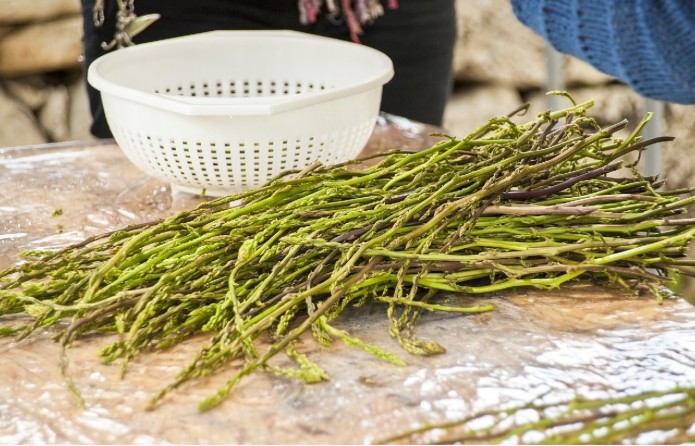
It’s when the wild asparagus sprouts pop out. The delicious and tender weed that grows abundant in the Tuscan countryside, mostly in arid environments, on open fields that haven’t been farmed in a while, or wherever there’s a cluster of trees. Its unique taste has been accompanying our great Tuscan culinary tradition since ages, and its multitude of uses in the kitchen have been passed on through generations in our family.

However, don’t get tricked by the name: wild asparagus sprouts are nothing like their cultivated peers, the common asparagus you can easily find at the grocery store. In fact, unlike the thick and woody sprouts of the common asparagus, the wild one is almost as thin as a grass blade, with a slightly bitter and pungent taste. Grandma always said “where there’s one there are hundreds,” and truly it is so, as wild asparagus grows rampant in big thick clusters, that we usually call “asparagiaie”.

As you might know, we’re all about keeping our traditions alive, so this is the perfect time of year to get together on Sundays, put on our rubber boots, and go hiking in the woods to find this nature’s delicacy. Sometimes, we even have a fun competition to see who can fill their basket the fastest, leaving the loser to do the hard work of cleaning and cooking the grunt once we get home. It’s a fantastic way to spend time with family or friends and bring home fresh, picked ingredients for a meal.

The best way to eat it?

But what do you do with so much of this wonderful stuff? You might be wondering. Well, even though we might have gathered a ton of wild sprouts in our baskets, it’s usually not enough. We enjoy this bounty in many ways, from eating them raw, freshly picked, or just seared with a drizzle of olive oil, black pepper, and salt, to dipping them into poached eggs. You can also combine them with classic pasta and a generous sprinkle of Parmesan shavings, or add them to a beaten egg or two and season them well for an exquisite Italian omelet with just a splash of fine balsamic vinegar.

It feels like there are as many risotto recipes as there are asparagus sprouts! But we’ve saved the best for last because there’s a dish in our family that’s been around for ages and keeps inspiring us: it’s the smooth, creamy risotto con gli asparagi, Giuseppina’s special dish for wild asparagus, and that’s why we’re always on the hunt for wild sprouts every year! Believe me, once you’ve had a taste of this beautiful spring dish, you won’t ever get enough of it. It’s nothing like the same old risotto you’re used to, it’s just so scented and delicate, yet distinctive and savory. Giuseppina sticks to and values her traditional family recipes of course, and you can only experience this live in her kitchen. But here’s a little secret I’m going to share with you: I know it might sound strange, but she never adds wine to simmer her wild asparagus risotto!

C – for Carnevale

… and other ancient Tuscan traditions

Semel in anno licet insanire” (once a year, it is allowed to act like crazy) – our ancestors used to say on February, during the most bizarre and outgoing celebration of the year.

The Carnival season is a tradition that we are carrying on since medieval times, when jesters used to run through the village, encouraging people – who were then oppressed by the system and used to live in extreme poverty – to parody the values of the society they lived in, and the authority of the severe political and religious commandments, by inverting the roles and creating the Backwards World, where they could disobey the rules and become whatever they wanted for a day, wearing the “clothes” of the character they were joking on, living in redundancy and acting like fools in the cheapest and most rumorous possible way.

This playful rebellion helped them get ready for Lent, the 40-day period of fasting and self-discipline where they’d give up meat and other practices to purify their bodies and souls before Easter. In fact, the word Carnival seems to have Latin origins, as “carne levare” or “carnelevarium” means “giving up on meat”, a practice apparently dated back to the Romans era.

To keep up with such a big commitment, people in the Middle Ages celebrated Carnival not just with jokes and feasting, but mostly by indulging in rich, greasy meals, pints of wine, and the sweetest desserts.

In Tuscany, we’re very connected to our old traditions, and thankfully, some of them are still a big part of our culture. When Carnival rolls around, local bakeries fill their counters with delicious sweet and fried treats, along with the traditional Tuscan dessert, which still has its original Renaissance recipe. We’re talking about the Berlingozzo (berlinˈgɔttso), a soft, moist, and flavored donut cake with one of the easiest and simplest recipes ever, just like our grandmothers used to make!

Origins of the name

This carnival dessert, disguised as a breakfast donut, used to be served on Fat Thursday, which in Florence was the day known as Berligaccio. This funny word, was the name of a fifteen-century Tuscan mask, used in Florence during Fat Thursday. It was represented by a mascot carried through the city’s streets, with loud shouts, colorful dances, and funny acting.

Just like “Carnevale”, it seems to have a Latin origin, from the word “berlengo,” which means “table.” This takes us back to the feasting and overindulging tradition of the Medieval period.

We also have a verb descended from it, that you can easily find in most of Boccaccio’s tales, as a proof of the ancient origins of this Tuscan custom. It’s “berlingare,” and it means to chat or talk nonsense after having a big meal and lots of wine. Giovanni Boccaccio, the local and most famous Late Medieval novelist, poet, and humanist from Certaldo, used this verb a lot in his works, especially when talking about or describing a female character, because he thought women were so gossipy about everything.

lasciamo stare l’alte e grandi millanterie ch’ella fa quando berlinga coll’altre femmine”() “Ma solamente per voglia di berlingare (…) di che ella è vaghissima, sì ben dir le pare” – Il Corbaccio (Laberinto d’Amore) di Giovanni Boccaccio

 “forget about her great bragging about (herself) she does when she chatters with other females (…) But only for the wish to chatter is she famous, even if she thinks she speaks out right” – Il Corbaccio (Laberinto d’Amore) by Giovanni Boccaccio

The Tuscan Berlingozzo

Fat Thursday is just around the corner, and after sharing all the fun things about this special time in Tuscany, we couldn’t let you go without trying some delicious Tuscan Carnival treats. As we get ready for our traditional feast next February 23rd in Certaldo, we’re excited to share the joy of making and enjoying this classic Tuscan dessert with you. So, let’s not keep talking and come to our delightful donut!

It all starts with a couple of fresh egg yolks, beaten with sugar until they’re light and fluffy, mixed with lemon zest and a splash of freshly squeezed lemon juice, some extra virgin olive oil, and a nice cup of Vin Santo, that’s the secret ingredient!

We love our Carnival desserts to be sweet and flavorful, but our ancestors didn’t have any artificial flavors back then. They simply used the ingredients they had at home, which is what makes it so special. Therefore, we follow the old ways and add our own homemade Vin Santo, a type of Italian dessert wine usually made from white grape varieties like Trebbiano and Malvasia. It’s hung and left to dry on racks in a warm, well-ventilated area. If you ever visit Certaldo or any part of Tuscany, you can taste this wonderful sweet wine with our traditional homemade almond cookies, which we serve as a dessert at the end of your meal. It’s one of our most important landmarks here, so don’t miss it!

Now, we’re adding the flour, which we’ve mixed with a bit of potato starch and a sprinkle of salt, along with a touch of baking powder. Next, we’ll gently fold in the beaten egg whites and pour the dough into a donut-shaped baking tin. Then, we’ll pop it in the oven for about half an hour to bake. That should give us plenty of time to relax and enjoy a glass of Vin Santo while getting our masks and costumes ready for the feast. Cheers!

Ingredients: berlingozzo toscano

  • 2 fresh eggs
  • 75g. Sugar
  • 1 lemon
  • 50 ml. Vin Santo
  • 50 ml. Extra virgin olive oil
  • 150 g. Flour
  • 25 g. Potato starch
  • 6g. Baking powder
  • 1 pinch of salt

What you need 

  • 20 cm. diameter baking tin

Method

  • Preheat oven to 170 C degrees
  • Bake for about 25-30 minutes

Enjoy!

V – for Vineyards

“While Nature Awakens” – behind the scenes

Every January is a fresh start here at Giuseppina’s Cooking School; as nature stirs, we get ready for a new year brimming with fantastic recipes, delicious homemade preserves, and exquisite Chianti wine straight from our vineyards.

The air is buzzing with excitement here, and as Giuseppina gets ready to welcome and delight her guests this season with new kitchen tricks and tips on her Tuscan recipes, we’re about to start preparing our vineyards for a fantastic harvest year of fresh, wonderful wine that will perfectly complement our local dishes.

Harvest is just the final act of a long year

Since nature can’t wait, the perfect moment has arrived for us to tend to our vines, ensuring they give us their best rewards. It’s a moment of deep devotion, focusing on the vine’s new vegetative growth, just as we would with one of our homemade pasta dishes or bread. We begin by “kneading” the soil just enough to allow it to breathe after a long, cold winter. Then, we add the “spices” (winter fertilizer) that will help the vine’s heart grow its best harvest, giving the wine that perfect blend of flavors that makes Chianti wine famous and loved worldwide. Now, we’re almost done, and we start trimming the vine, restoring its shape. It’s probably the most important part of the work because a clean-shaped vine means a richer harvest. As an old saying goes, once a vine told its owner:

fammi povera e ti farò ricco

(Keep me poor -of unwanted trims- and I will make you rich -of the best grapes-).

The vine is a symbol of abundance, representing love for the land in the form of grapes. To create the best wine, it requires a deep passion and unwavering perseverance, fully utilizing the incredible qualities that Chianti’s land offers.

The wine harvest and tasting are the culmination of a year of dedicated effort and care, which we’re excited to share with our guests. We aim to take them beyond the typical tourist spots, beyond just a simple wine tasting or a casual visit to the vineyards, offering them a genuine experience of growing Chianti vines and becoming part of the story.

We’re here to provide them with the authentic experience of Chianti vine cultivation, making them an integral part of the journey.

modif.1